How to Compare Roanoke VA Neighborhoods When Your Commute Matters
Choosing a Roanoke-area home is easier when the search starts with the life you need the home to support. A listing can look close to work on a map and still feel very different on a Monday morning, after school, or when a routine errand takes you across the valley.
Commute time should not be the only reason to choose a neighborhood. It is one of the daily costs of a home, though, and it is worth testing before you fall in love with a house. The goal is not to find a perfect number. It is to understand the route, the schedule, and the tradeoffs well enough to make a decision you can live with.
Start with the places you visit every week
Before comparing listings, write down the destinations that shape your normal week. Start with work, school or childcare, grocery shopping, and medical care. Add the homes of people you see regularly when those trips matter to your routine. Four or five real destinations tell you more than a Google map view.
Then decide which trips matter most. A buyer who works from home most days may care more about school drop-off and access to a grocery store. Someone who drives to an office every weekday may accept a smaller yard or a different home style to avoid a route that is frustrating twice a day.
If your search is centered on the city itself, our Roanoke area home-buying guidance can give you a starting point for the local questions to ask. It should support your own route testing, not replace it.

Test the address at the times you will actually drive
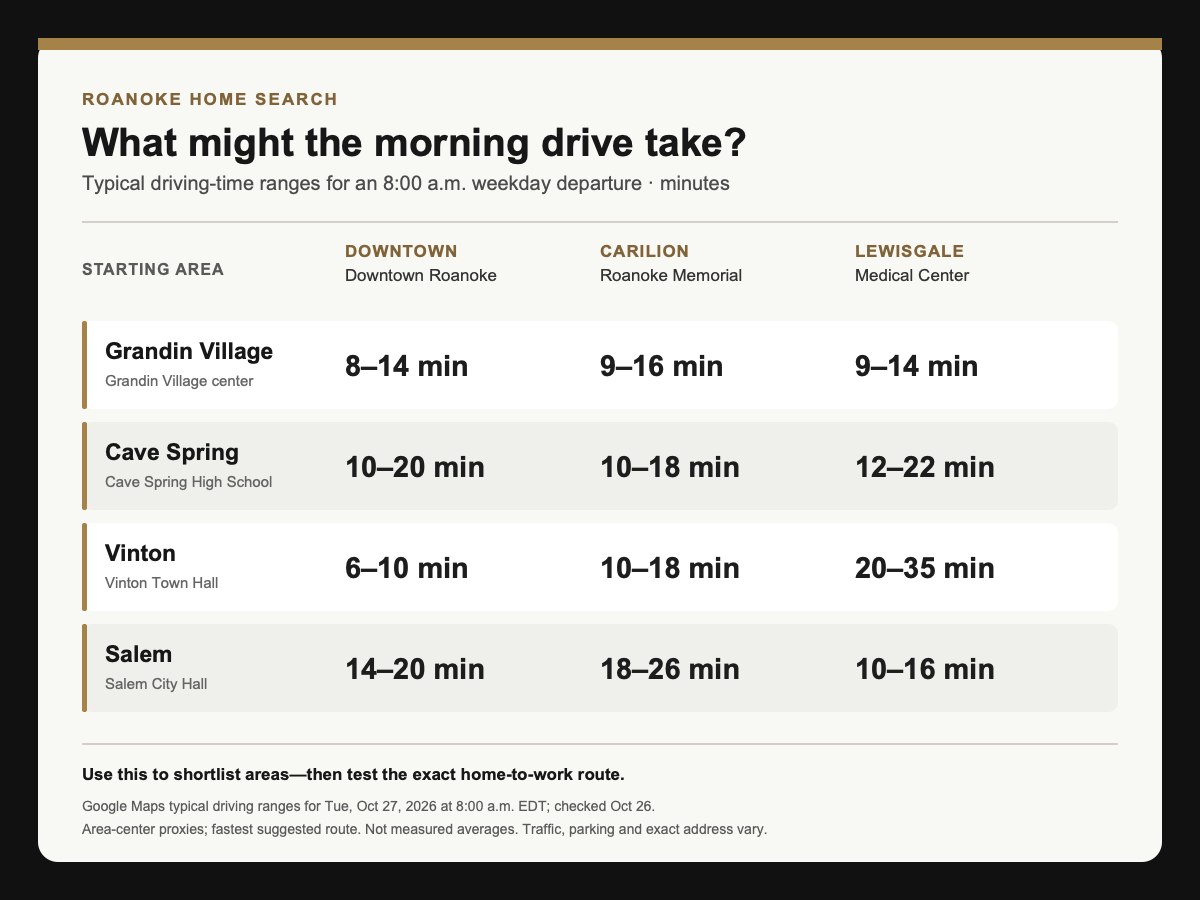
A listing map is a useful first look, but it is not a real life commute test. Put the exact address into your preferred navigation app and check the trip for the time you normally leave and return. Repeat that test on more than one weekday if the route is important to your decision.
Look at the range, not just the fastest estimate. A route that usually takes 18 minutes but occasionally takes 35 may affect your family more than a steady 24-minute drive. Notice where the delay appears. Is it near a school, at a bridge, on an entrance ramp, or on a road with long term construction? The answer helps you understand whether the inconvenience is occasional or built into the route for the foreseeable future.
Do the same test for the return trip. Morning and afternoon traffic do not always build in the same places. If you are considering a home in the western part of the valley and working east of the city, or the reverse, test both directions before you make assumptions about the neighborhood.

Compare the route, not only the minutes
Two homes can have similar drive times and still create very different days. One route may be simple and predictable. Another may involve several turns, a steep grade, a narrow road, or a difficult left turn. A few extra minutes may be a fair trade for a route that feels calmer and gives you more than one way home.
It also helps to separate a work commute from the rest of your weekly movement. If a house makes the office trip shorter but adds 15 minutes to school drop-off, shopping, or medical appointments, the total tradeoff may not be what you expected. Bring the actual schedule into the conversation rather than judging the address from one trip.
Use local data as context, not as a promise
The Virginia Open Data Portal's 2024 ACS 5-year county file gives useful context for how travel times are distributed. In the Roanoke County row, an estimated 15,417 workers fell in the 10-to-24-minute travel-time bands, while 8,511 fell in the 30-minutes-or-more bands. In Botetourt County, the corresponding estimates were 4,509 and 3,775.
Those figures are counts of workers in county-level American Community Survey estimates. They are not a prediction for a particular street, a live traffic report, or a promise that a buyer will have a certain commute. The file also carries margins of error because the ACS is based on a sample. The data is useful for seeing that county-level patterns are mixed; it is not a substitute for testing the address.
The source is the Virginia travel-time dataset, which identifies the source as the U.S. Census Bureau's American Community Survey 5-year estimates, Table B08534. The figures above use the 2024 reporting row and were checked on October 23, 2026.
Ask the property questions that affect daily driving
Once a home makes the short list, ask questions that connect the route to the property. Confirm whether the road is publicly maintained and whether seasonal access creates concerns. Look at driveway drainage, then check for restrictions on parking or turning around. A home can be close to the places you need to go and still be harder to use than the map suggests.
Ask how the current owners use the home, too. Their answer will not tell you what your commute will be, but it may reveal details worth checking. A seller who works a different shift may not experience the same traffic pattern. A family that rarely drives during school arrival may not notice a delay that matters to you.
The final step is to compare the commute with the rest of the property decision. Consider condition, monthly cost, neighborhood fit, and resale potential together. Then account for the work needed after closing. A shorter route is helpful, but it should not hide a repair issue or make you stretch beyond a comfortable budget.
When you are ready to talk through the full search, J&D's home-buying process is built around comparing the details that a listing page cannot explain on its own. Bring the addresses and your real weekly schedule. That gives the conversation somewhere practical to start.

Roanoke commute and neighborhood FAQs
How can I compare commute times between Roanoke and Salem?
Test each exact address at the times you expect to drive, in both directions. Compare the range of results and the route itself. A short distance on a map may still involve a different bridge, school zone, or approach road.
Is a 20-minute commute realistic for a Roanoke-area home?
It may be, but a general area label cannot answer that for a particular property. Check the weekday departure and return times, then ask what happens when weather, school traffic, or an incident changes the normal route.
Should commute time determine which Roanoke neighborhood I choose?
It should be one part of the decision. Think about how often you make the trip, whether the route is predictable, and what the home gives up or adds in condition, cost, space, and neighborhood fit.
What should I ask about a home's road access?
Ask about maintenance, drainage, driveway use, and parking. Check alternate access separately. If an answer involves title, legal, insurance, or engineering details, have the appropriate professional verify it rather than relying on a casual description.
Cover photo: Famartin (CC BY-SA 4.0); image used unmodified.