Buying a Home Near Roanoke VA: How Local Property Taxes Can Change the Monthly Cost
When you search for homes near Roanoke, the first numbers you usually see are the list price and an estimated monthly payment. Property taxes can change that payment, especially when two similar homes sit in different localities. The tax bill depends on the assessed value, the local rate, and the rules that apply to that property. It is worth checking before you decide that a home fits your budget.
Roanoke City, Roanoke County, Botetourt County, and Salem do not all use the same tax structure. Vinton and nearby areas can raise additional jurisdiction questions. J&D's home-buying guidance can help you organize the broader search, but the tax question is specific to each address. Treat a listing estimate as a starting point and verify the bill through the appropriate locality.
Start with the locality, not the tax number
A home may be marketed as a Roanoke-area property even when the tax bill comes from the City of Roanoke, Roanoke County, the Town of Vinton, Botetourt County, or another locality. The address and parcel determine which government assesses the property and which rates apply. A city or town boundary can change the calculation without changing the way a listing looks online.
Vinton is a useful example. The town's published real-estate rate is separate from Roanoke County's rate, and Vinton says town residents also pay county real-estate taxes. That means a buyer comparing a Vinton address with a county address should ask about the combined bill rather than looking only at the town rate.
If you are comparing locations, J&D's Roanoke-area guide can help with the geography. Once you have a specific property, confirm the locality, parcel, current assessment, and tax bill before you build a monthly budget around it.
Use the rate as a comparison, not a final estimate
For calendar year 2026, the published real-estate rates used in this guide are $1.22 per $100 of assessed value in the City of Roanoke, $1.03 in Roanoke County, and $0.70 in Botetourt County. The Town of Vinton publishes a town rate of $0.07 per $100, but that is not the whole property-tax picture for a Vinton resident because the county tax also applies.
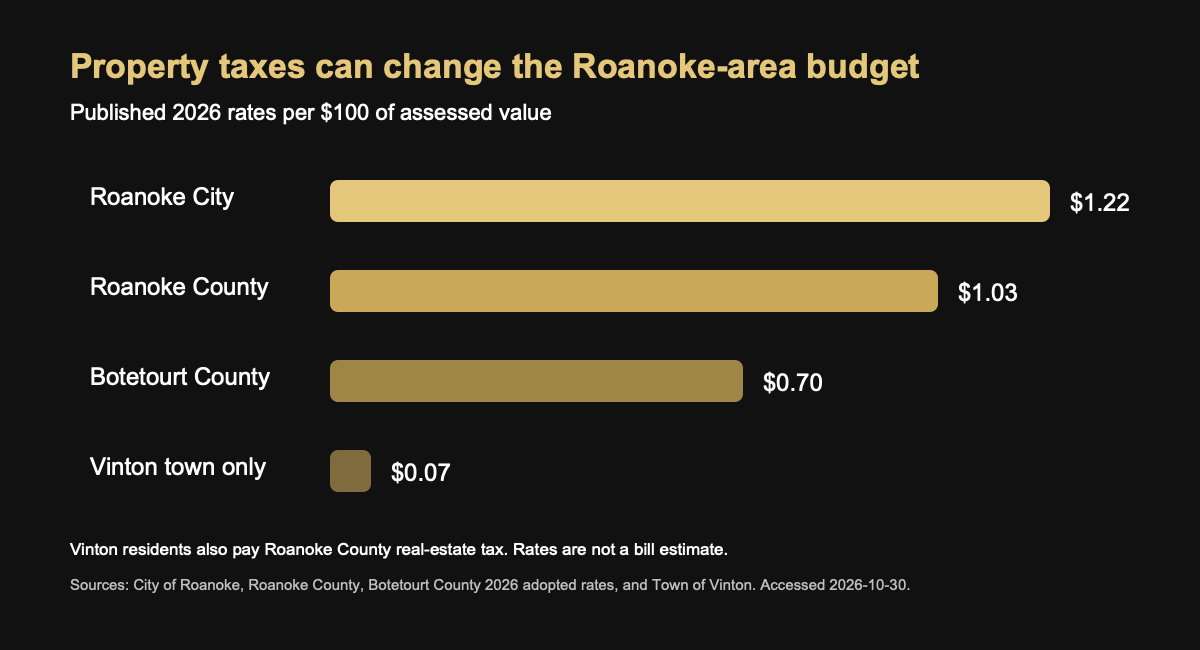
On a hypothetical assessed value of $400,000, a simple rate calculation would be about $4,880 per year in Roanoke City, $4,120 in Roanoke County, and $2,800 in Botetourt County. A Vinton example would be about $280 for the town portion plus about $4,120 for the county portion, or roughly $4,400 before any other applicable items. These are illustrations, not quotes for a particular property.

The difference matters, but it should not decide the purchase by itself. A home with a lower tax rate may have a higher assessed value, different insurance costs, more maintenance, or a longer commute. Compare the complete home and the complete monthly cost instead of treating one rate as a shortcut for value.
Find out how the assessment affects the bill
Virginia property taxes are generally calculated by applying the locality's rate to the assessed value. The assessed value is not automatically the same as the contract price, and a listing's tax field may not reflect a future reassessment or a change in ownership. Ask for the current assessment and the most recent tax bill so you can see the actual starting point.
Also ask what the assessment includes and whether the property has features that could affect it. Finished space, additions, outbuildings, and acreage may raise questions for the assessing office. A change in use may matter too. That does not mean a feature is a problem. It means you should know which facts the locality has on record.
Do not assume an exemption, tax relief program, or special assessment transfers automatically with the property. Eligibility can depend on the owner, use, age, disability status, or other rules. The Commissioner of the Revenue, assessor, or treasurer is the right source for a property-specific answer.
Put property taxes beside the rest of the monthly cost
When you compare two homes, convert the annual tax estimate into a monthly planning number. Put it beside principal, interest, homeowners insurance, and mortgage insurance if applicable. Add utilities and a maintenance reserve, plus an association fee when the community has one. A small difference in tax rate can be less important than a roof that needs replacement or an insurance quote that comes in higher than expected.

Escrow adds another layer. A lender may collect tax and insurance payments with the mortgage, but the lender's estimate is still based on the information available at the time. Ask how the tax amount was calculated and what happens if the bill changes. If you are paying taxes directly, confirm the due dates and payment method with the locality.
The goal is a budget you can live with after closing, not a payment that looks comfortable only because one line item was left out. A careful comparison gives you a better conversation with your lender and a clearer sense of which home fits your plans.
Questions to ask before you make an offer
Ask for the current tax bill and assessed value for the exact parcel. Confirm whether the address is inside a city, town, or county boundary and whether more than one locality's tax applies. Ask whether the listing uses the current assessment or an older figure. If a home was recently renovated, added onto, subdivided, or converted to a different use, ask what has been reported to the assessing office.
Then ask your lender how the tax number will affect the payment and whether escrow will be required. If the property has an exemption, special district charge, or other local item, ask the responsible office whether it continues after the sale. These questions are easier to answer before you write an offer than when you are trying to compare loan documents at the end of the process.
J&D can help you compare properties, organize questions, and keep the tax bill in context with price, location, condition, and commute. The locality, lender, tax professional, and other qualified professionals remain the right sources for official calculations and specialized conclusions.
Roanoke-area property tax FAQs
Are property taxes based on the home's list price?
Not necessarily. The tax calculation uses the locality's assessed value and tax rate. The assessment may differ from the list or contract price, and it can change under the locality's assessment process. Ask for the current assessment and tax bill for the parcel.
Why can two similar homes have different tax bills?
They may be in different localities, have different assessed values, or have different property features and tax arrangements. Homes near a boundary can look similar in a search but carry different local charges. Compare the exact parcel and current bill.
Do Vinton homeowners pay both town and county real-estate taxes?
Vinton's official tax information says town residents also pay Roanoke County real-estate taxes. The town rate is therefore only one part of the calculation. Confirm the current town and county amounts for the property you are considering.
Can a property tax exemption transfer to a buyer?
Do not assume it will. Eligibility and transfer rules depend on the program and the new owner's circumstances. Ask the appropriate Commissioner of the Revenue or treasurer's office for a current answer.
How can J&D help me compare homes with different tax bills?
J&D can help you compare the addresses, organize the questions, and look at taxes alongside price, condition, location, and commute. Your lender and the relevant locality remain the sources for the final payment and tax figures.
If two homes both seem to fit your search, take a few minutes to compare the actual tax setup before you choose. The right home is the one whose total cost and day-to-day fit make sense together.