Buying a Home Near Roanoke VA: How to Check What Can Change Around the Property
A house can fit your budget and look right in person, but the land around it still deserves a closer look. The vacant lot behind the fence, the parcel across the road, or the wooded edge beside the driveway may not stay exactly as it appears today.
That does not mean a change is coming. It means a listing cannot answer every question about nearby land or your ability to add a garage, fence, room, or driveway. Before you make an offer near Roanoke, review the available map information, ask a realtor who knows, and separate what is allowed from what has actually been proposed.
Start with the exact locality and parcel
"Roanoke area" covers several jurisdictions. A home in the City of Roanoke is not reviewed through the same office or map system as a home in Roanoke County. Salem, Vinton, Botetourt County, and other nearby locations have their own records and processes too.
Begin with the exact address and parcel. Confirm the locality, parcel number if available, and the source of the map you are reading. The City of Roanoke says its official zoning map is available through its Real Estate GIS site and includes planning and zoning layers. Roanoke County also maintains a GIS system and zoning data. Those tools can help you ask a better question, but they are not a substitute for confirmation from the office that controls the property.
This matters when a listing uses a familiar community name that crosses a boundary. A home may be marketed as being near Roanoke while the zoning, building rules, tax records, and permit contacts belong to another locality.

Look at the parcels next to the home
Do not stop at the parcel with the house. Open the map far enough to see the lots around it. Note whether the neighboring land is a separate parcel or part of a larger tract. It may also be a public right of way, common property, or an unusually shaped lot.
Then ask what the adjacent parcel's current zoning and permitted uses are. A wooded lot may remain wooded, but a buyer should not treat that as a permanent promise. A large parcel can have a different development path from a small residential lot. A commercial or institutional use nearby may affect traffic, noise, or lighting. Parking and the feel of the street can matter too, even when the current view is quiet.
Virginia's current Residential Property Disclosure Statement specifically tells purchasers that the owner makes no representation about adjacent parcels, including their zoning classification or permitted uses. The notice also directs buyers to conduct the due diligence that fits the property and the contract. For a buyer, that is a useful distinction: the seller's disclosure and the public record answer different parts of the question.
You do not need to predict the future from a map color. You need to identify what remains unknown and decide which answer matters enough to investigate before the contract deadlines pass.

Separate current zoning from future plans
Zoning tells you what a locality's rules allow in a district. It does not tell you that a particular project has been approved, funded, or scheduled. A project discussion or application does not mean every possible version will be built.
When the land around a home matters to you, check for more than the district label. Look for planning or zoning notices, subdivision or site-plan information where the locality makes it available, public hearing material, and transportation or capital-project information that affects the area. If you find a project name or case number, use that exact identifier when you contact the responsible office.
The question should match the concern. If you are worried about a new driveway behind the property, ask about access and the adjacent parcel. If you are worried about a taller structure, ask about the district's height and setback rules. If you want a quiet view, ask whether the land is protected by an easement, conservation restriction, or another recorded limitation rather than relying on the current tree line.
A general internet search may surface old news, neighborhood discussion, or a different property with a similar address. Use it as a lead, not as the final answer. The current locality record and a qualified professional are better places to resolve a property-specific question.
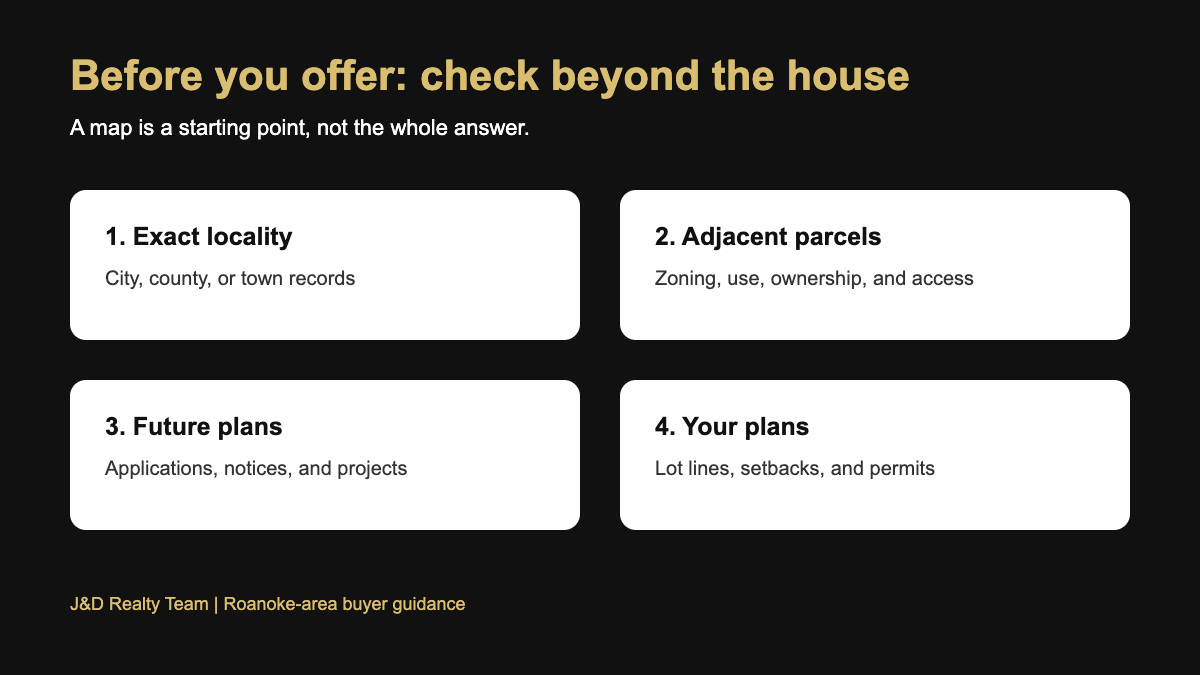
Check whether your own plans fit the property
Buyers often focus on what could happen next door and forget to verify what they want to do themselves. If your plan includes a detached garage, pool, or addition, treat it as a separate research item. The same is true for a fence, home business, second dwelling, or major driveway change.
Verify the lot lines before you plan around the edge of the yard. Ask the locality about zoning, lot coverage, height, and setbacks. Then ask about any permit or review process that could apply. A survey may be appropriate when the boundary matters. A listing measurement or fence location is not automatically a legal boundary.
Historic district rules, resource protection areas, easements, and shared access can add another layer. They do not automatically make a property a bad fit. They can change the timing, cost, design, or approval path for an improvement. If a plan is important to your decision, get the relevant answer in writing from the appropriate office or professional before treating it as part of the home's value.
This is especially important when comparing different parts of the Roanoke Valley. A city lot, a county lot, and a home in a nearby town may offer similar bedrooms and price points while having different rules about additions, parking, accessory structures, or land use.

Use the contract period to replace assumptions with evidence
The best time to investigate a zoning or adjacent-land question is before you are committed to the purchase. Keep a written list of the questions, the office contacted, and the document or map used. Save the parcel number and the version of any online material you rely on.
Ask your real estate professional to help organize the questions and deadlines. Ask the locality about zoning and planning. Ask a title professional or attorney about recorded easements, restrictions, and other legal documents. Ask a surveyor about boundary questions. The right source depends on the issue.
Do not let a confident answer from a listing description or a neighbor replace the official record. Do not assume that a zoning map proves a project is coming, either. The useful result is a narrower decision: the property fits, the concern needs more information, or the uncertainty is large enough that you should keep looking.
Roanoke property-change FAQs
Does zoning tell me exactly what will be built next to a home?
No. Zoning describes allowed uses and development rules for a district. It does not prove that a project is planned or that every permitted use will occur. Check the current locality records and ask about any specific application or case that concerns you.
How do I find the zoning for a Roanoke-area property?
Start with the exact address and locality. City of Roanoke properties can be checked through the city's zoning and Real Estate GIS resources. Roanoke County provides its own GIS and zoning data. Salem, Vinton, Botetourt County, and other jurisdictions have their own offices and systems.
Should I worry if a vacant lot is beside the house?
Not automatically. Find out who owns it, whether it is a separate parcel, its current zoning, and whether there are recorded restrictions or a current application that matters. A vacant lot can remain unchanged, but the present appearance alone is not a guarantee.
Can I rely on the seller's disclosure statement for adjacent-property questions?
Use it as one source, not the whole investigation. Virginia's disclosure notice says the owner makes no representation about adjacent parcels and advises the purchaser to conduct necessary due diligence. Read the actual disclosure, then check the locality and other records that apply to your question.
What if I want to add a garage or finish a plan after I buy?
Check the lot lines, zoning district, setbacks, and lot coverage. Then review access, utilities, easements, and any historic or environmental review that could apply. Ask the locality and the appropriate professional before you assume the project is feasible.
Buying a home near Roanoke is easier when the map, the property, and your plans all tell the same story. J&D Realty Team helps buyers organize those local questions before they become surprises. See the buying guidance for a Roanoke-area search.